
Native Time: My contribution for the Book of Time Lab, by The Long Now Foundation
How much time is already inside us
What does long-term thinking look like in practice?
The Long Now Foundation have set up Long Now Labs, a collaborative space to test, prototype, and build long-term tools.
Lab 001.1: Book of Time is part of this series, and it is a collaboration with the Protocol Institute to investigate three aspects of civilizational durability that are being radically reshaped by frontier technologies.
In May, they shared a public call for contributions to this ambitious project (see this LinkedIn post as an example) and I had some ideas to work on my contribution. (See project details if you are curious.)
Last week, I received an email by Denise Hearn saying that my contribution is not selected. I had an exhilarating experience while working on my proposal and I am sharing it in this post.
Native Time
In 2024, the Dunedin Airport had a new sign that read—"Max hug time 3 minutes" (reference). The CEO explained this is enough to release oxytocin and serotonin—enough to say goodbye. The sign is well-intentioned. It is also a precise measure of civilizational failure. The native time of a farewell is not three minutes. It is the accumulated weight of a relationship, the distance being created, the uncertainty of return.
An institution with no instrument for reading that simply imposes the only clock it has.
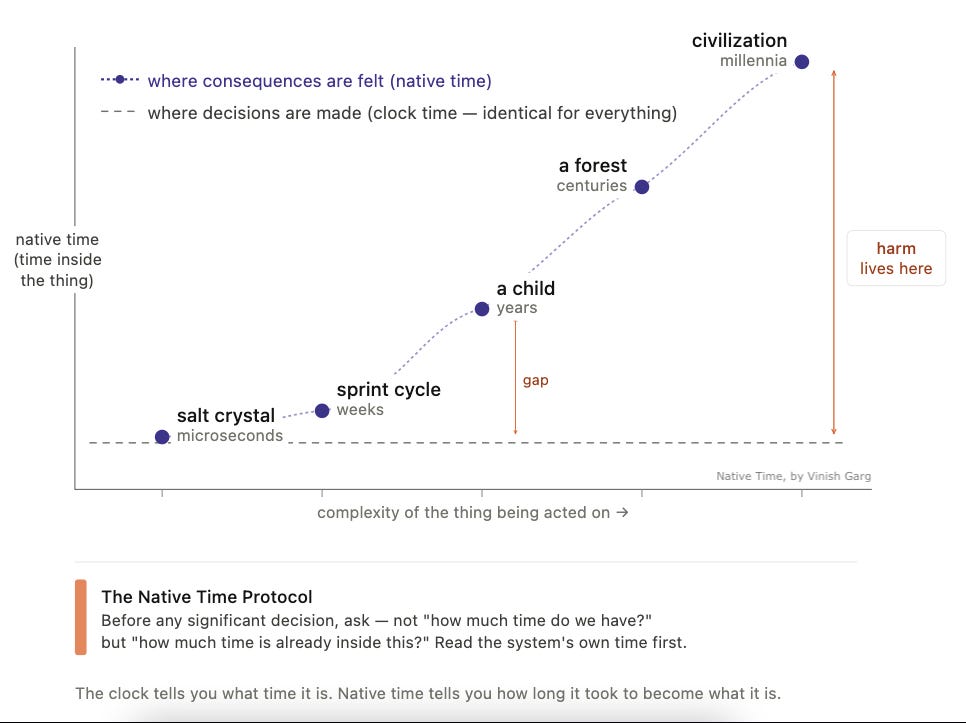
Every object, system, and living thing carries a native time—the temporal scale at which it was assembled, at which it unfolds, and at which its consequences become legible. A child has a native time of years. A forest has a native time of centuries. A civilization has a native time of millennia. Assembly theory now gives this physical grounding: complex objects do not exist outside of time—time is inside them, measurable, real.
The civilizational failure is not that we measure time poorly. It is that we impose a single external tempo—the sprint, the quarter—onto the systems with totally different native times.
A product team acts on a new user's first moment of trust with the same clock they use to ship code. A policymaker designs education reform on a four-year political cycle while a child's development runs on its own, longer, non-negotiable one.
The clock arrived late. Time was already working inside the thing being acted upon.
The concept is: A Native Time Protocol—a standard that, before any significant decision, requires reading the native temporal scale of the system being acted on. Not "how much time do we have?" but "how much time is already inside this?"
The prototype: a companion instrument to any decision-making process—not displaying clock time remaining, but the native time of what is being designed for.
(I shared the following visual to support my proposal.)
For a leader in a room, this is timing.
For a grandmother raising a child, this was always the only clock that mattered.
I think I am a better designer after working on this proposal. My next project could show it. Watch out.